

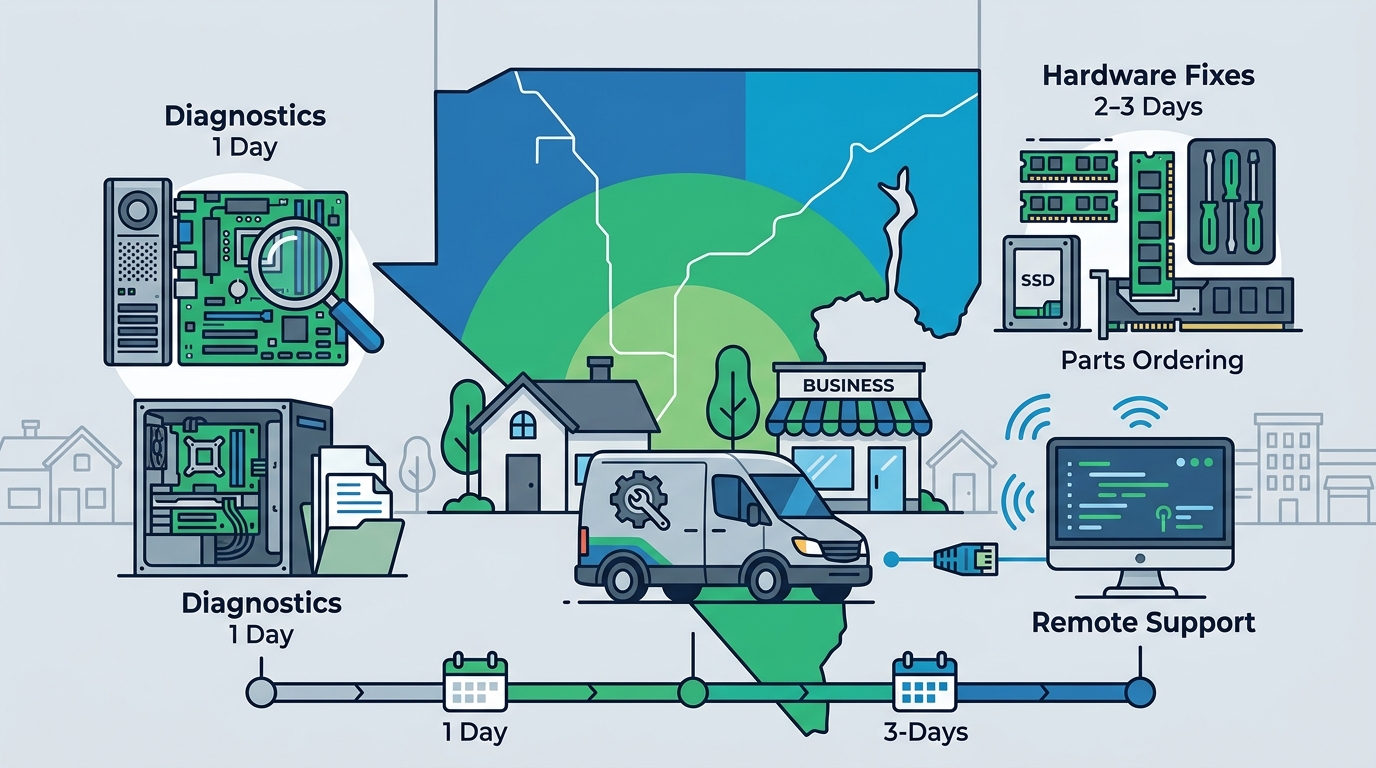
Doctor of Technology typically completes on-site computer repairs in Clark County within one to three business days, depending on the issue. This guide explains how turnaround times work for diagnostics, hardware fixes, and remote support. We cover what to expect at each stage of the repair process. For additional details, review the 403 Forbidden.
Business Day Turnaround
Business day turnaround is the standard timeframe for most on-site computer repairs. For Doctor of Technology in Clark County, this usually means one to three business days from the initial visit. The exact duration depends on the specific problem and whether parts are needed. Most software issues and minor hardware fixes fall into this category. For additional details, review the .
When a technician arrives, they first assess the device. If the issue is straightforward, such as a slow boot or a minor driver conflict, the repair often happens during that first visit. If a part is required, the technician may order it and return on a subsequent day. This model ensures that repairs are done correctly without rushing the process. For additional details, review the Customer Experience.
Factors Influencing Business Day Timing
Several factors affect how long a repair takes. The complexity of the issue is the primary driver. A simple virus removal might take a few hours, while a full system reinstallation could take a day. Part availability is another key factor. Common parts like SSDs and RAM are often in stock, while specialized components may take longer to source. For additional details, review the Frequently Asked Questions.
Customer availability also plays a role. On-site repairs require the customer to be present or to grant access to the device. Scheduling conflicts can sometimes extend the timeline. Doctor of Technology works to minimize these delays by offering flexible appointment windows. For additional details, review the About.
Same Day Diagnostics
Same day diagnostics is the initial assessment phase of the repair process. Doctor of Technology performs this step during the first on-site visit. The goal is to identify the root cause of the problem and provide a clear estimate for the repair. This step is crucial for setting accurate expectations.
During the diagnostic visit, the technician runs a series of tests. These tests check hardware health, software stability, and network connectivity. The results are shared with the customer immediately. This transparency helps customers make informed decisions about whether to proceed with the repair.
What Happens During Diagnostics
The diagnostic process involves both automated tools and manual inspection. Automated tools scan for malware, check disk health, and monitor system performance. Manual inspection involves checking physical connections, inspecting for damage, and verifying component compatibility. This dual approach ensures a thorough assessment.
Once the diagnosis is complete, the technician explains the findings in plain language. They outline the recommended repair steps and provide a cost estimate. The customer can then approve the work or choose to decline. This collaborative approach builds trust and ensures customer satisfaction.
Complex Hardware Repairs
The longer timeline is due to the need for specialized parts and careful handling. Motherboards, for instance, must be matched to the specific device model. Screens require precise calibration and testing. Data recovery involves delicate procedures to extract information from failing drives. These tasks require time and expertise to ensure success.
Parts Availability and Lead Times
Parts availability is a major factor in complex repair timelines. Common parts are often available locally, but specialized components may need to be shipped. Shipping times can add one to three days to the overall turnaround. Doctor of Technology keeps customers informed about part status throughout the process.
Remote Support Speed
When Remote Support is Applicable
However, remote support has limitations. It cannot fix physical hardware issues like a broken screen or a failing hard drive. In these cases, an on-site visit is necessary. Doctor of Technology helps customers determine the best approach based on the specific issue. This ensures that the right solution is applied quickly.
Key Takeaways
- Business day turnaround for most on-site repairs is one to three days.
- Same day diagnostics are performed during the initial visit to set expectations.
- Complex hardware repairs may take three to seven days due to parts and testing.
- Parts availability significantly impacts the timeline for hardware repairs.
- Customer availability and scheduling can affect the overall repair duration.
- Transparent communication is key to managing expectations during the repair process.
Frequently Asked Questions
How long does a typical on-site repair take?
A typical on-site repair takes one to three business days. The exact time depends on the issue and whether parts are needed.
Can you diagnose my computer on the same day?
Yes, Doctor of Technology performs same day diagnostics during the initial visit. This helps identify the problem and provide an estimate.
How long do complex hardware repairs take?
Complex hardware repairs can take three to seven business days. This is due to parts availability and the need for thorough testing.
Is remote support faster than on-site repair?
Do I need to be present during the repair?
Yes, you need to be present or grant access to the device for on-site repairs. This ensures the technician can work efficiently.
What if the part is not in stock?
If a part is not in stock, the repair timeline may extend. Doctor of Technology keeps you informed about part status and expected arrival.
Can you recover data from a failing drive?
Data recovery is possible in many cases, but it is not guaranteed. The success depends on the extent of the drive failure. Learn more: 403 Forbidden.