
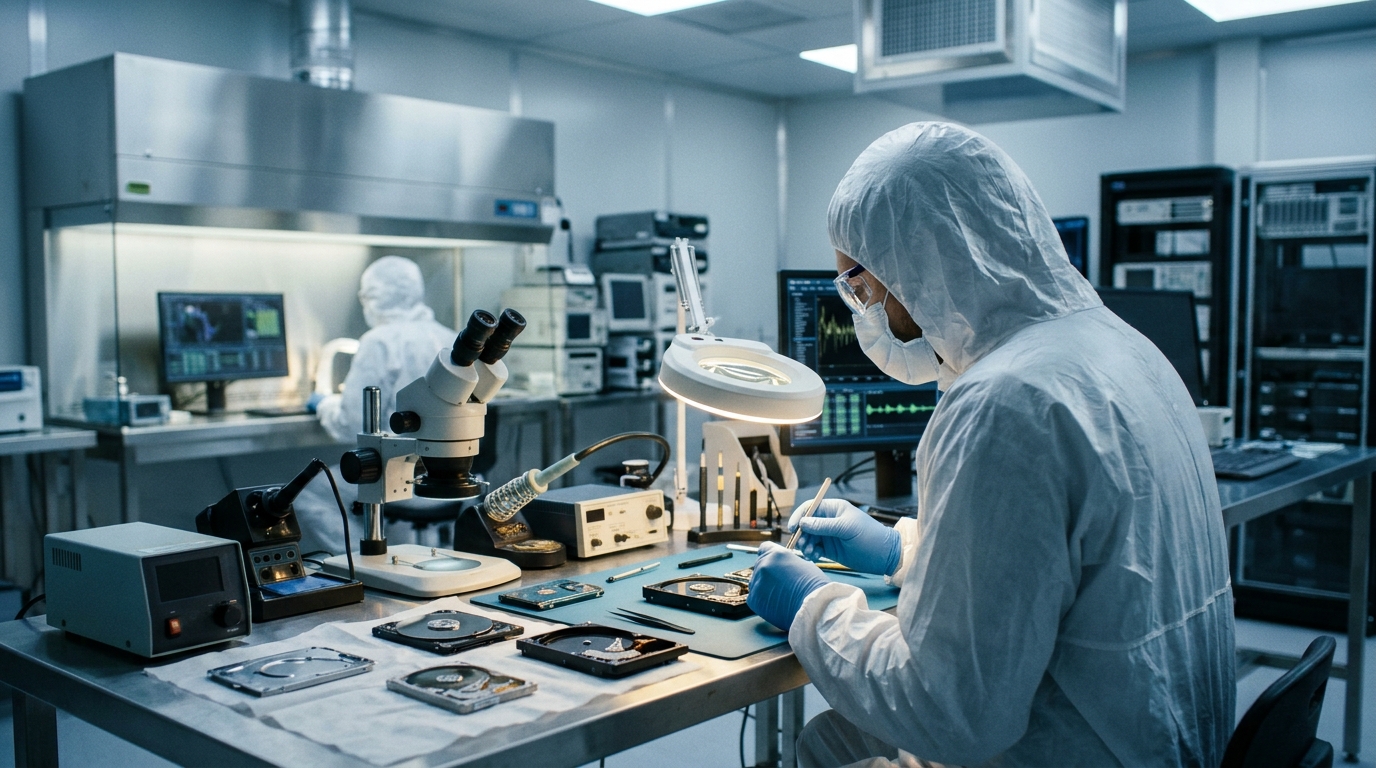
When a hard drive fails, the data inside is trapped behind physical barriers that standard tools cannot cross. A cleanroom is a controlled environment that minimizes airborne particles to allow technicians to open sealed drives safely. In Las Vegas, specialized cleanroom environments are used to handle mechanical failures that would otherwise destroy the platters. This process requires strict adherence to ISO standards to prevent microscopic dust from causing permanent data loss.
The Critical Role of Particle Control
Airborne dust is the primary enemy of magnetic storage media. Even a particle as small as 0.5 microns can scratch a platter surface, rendering the data beneath it unreadable. A cleanroom is a specialized facility that maintains air quality through high-efficiency particulate air (HEPA) filtration systems. These systems remove 99.97% of particles larger than 0.3 microns from the air. In a Class 100 cleanroom, there are no more than 100 particles per cubic foot of air. This level of control is essential because standard office air contains thousands of such particles per cubic foot.
Technicians must wear full bunny suits, including hoods, gloves, and shoe covers, to prevent shedding skin cells and fibers. The environment is also pressurized to ensure that air flows out of the room, preventing unfiltered air from entering. Without this pressure differential, opening a drive in a standard room would immediately contaminate the platters. The goal is to create a sterile space where the delicate magnetic surfaces remain intact during disassembly.
Disassembling the Sealed Drive
Modern hard drives are sealed at the factory to maintain a vacuum or helium atmosphere. Opening this seal in a non-cleanroom environment causes immediate oxidation and contamination. Technicians use specialized tools to remove the top cover without applying uneven pressure. The drive head assembly is then carefully detached from the actuator arm. This step requires extreme precision because the heads are designed to float nanometers above the platter surface. Any contact between the head and the platter during removal can cause a head crash.
Once the drive is open, technicians inspect the platters for physical damage. They look for scratches, debris, or signs of head impact. If the platters are clean, the heads can be replaced with known-good spares. This process is known as head replacement. It is one of the most common procedures in cleanroom recovery. The new heads must be calibrated to match the specific geometry of the platters. This calibration ensures that the read/write elements align correctly with the data tracks.
Platter Imaging and Data Extraction
After the drive is opened and heads are replaced, the next step is imaging the platters. Imaging is the process of creating a bit-for-bit copy of the drive's contents. Technicians use specialized hardware to read the raw data from the platters. This data is then written to a new, healthy drive. The imaging process is slow and requires the drive to spin at a constant speed. Any vibration or temperature fluctuation can cause read errors. Therefore, the cleanroom environment must remain stable throughout the process.
Once the image is created, technicians use software to reconstruct the file system. They analyze the image to identify partition tables, file allocation tables, and individual files. This step is known as logical recovery. It allows the recovery of data even if the file system is corrupted. The final output is a set of files that the user can access on a new device. This process ensures that the original failed drive is never used again, preserving the data for future reference if needed.
Why Standard Repair Shops Cannot Do This
Most computer repair shops do not have cleanroom facilities. They rely on logical recovery tools that work only when the drive's mechanical components are intact. If a drive has a mechanical failure, such as a stuck spindle or clicking heads, logical tools will not work. In fact, using these tools on a mechanically failed drive can make the situation worse. The drive may spin up and down repeatedly, causing further damage to the platters. This is why it is crucial to stop using a failed drive immediately.
Only specialized data recovery centers have the equipment and expertise to perform cleanroom procedures. These centers invest in Class 100 or better cleanrooms and employ trained technicians. The cost of cleanroom recovery is higher than logical recovery due to the specialized equipment and labor involved. However, it is the only option for saving data from mechanically failed drives. For businesses in Las Vegas, having a relationship with a reputable recovery center can be a critical part of disaster recovery planning.
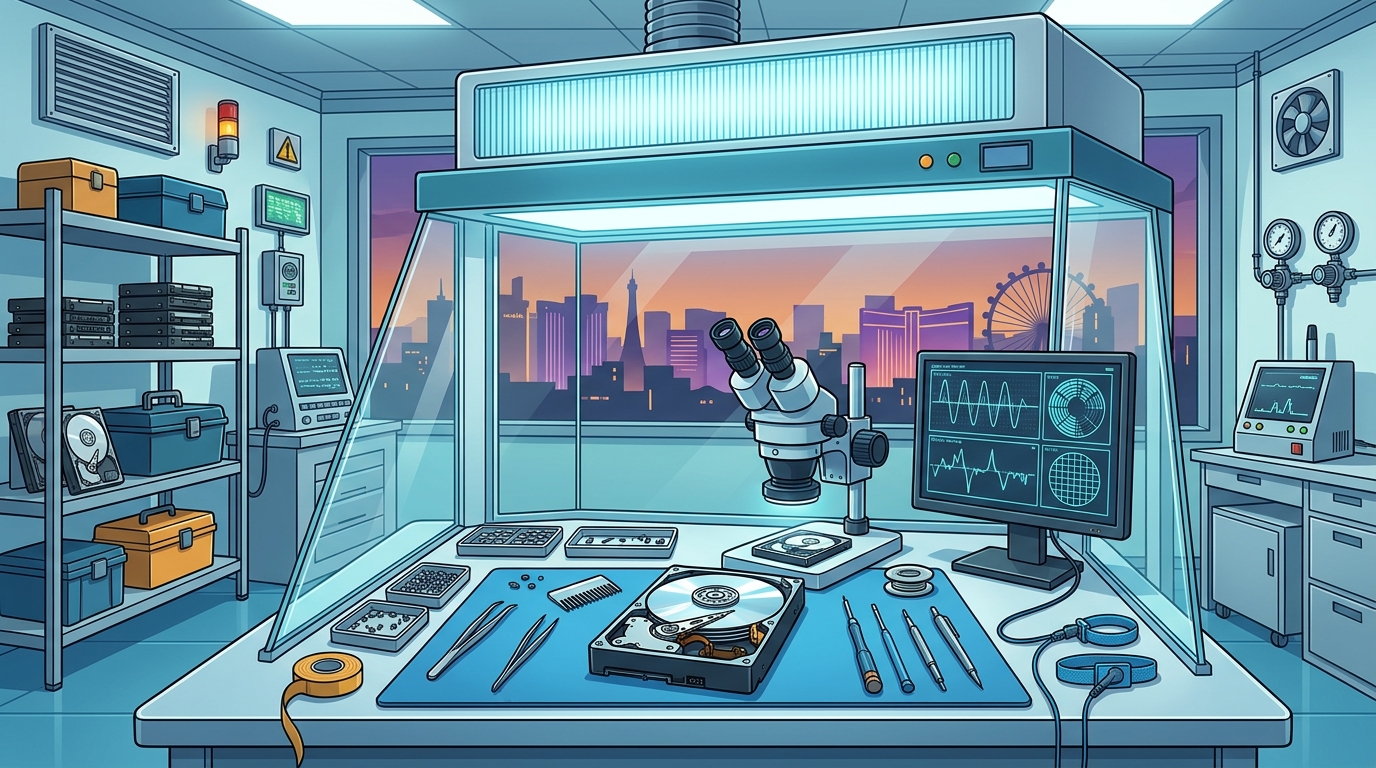
Key Takeaways
- A cleanroom is a controlled environment that filters air to prevent dust from damaging hard drive platters.
- Technicians wear full protective suits to prevent shedding particles into the cleanroom.
- Head replacement is a common cleanroom procedure that involves swapping damaged read/write heads with spares.
- Imaging creates a bit-for-bit copy of the failed drive's data before logical reconstruction.
- Standard repair shops cannot perform cleanroom recovery due to the lack of specialized facilities.
- Stopping use of a failed drive immediately is essential to prevent further physical damage.
Frequently Asked Questions
What is a cleanroom in data recovery?
A cleanroom is a specialized facility that maintains strict air quality standards to prevent dust and particles from contaminating hard drive platters during repair.
Why can't I open my hard drive at home?
Opening a hard drive outside a cleanroom exposes the platters to airborne dust, which can scratch the magnetic surface and permanently destroy the data.
What is a head crash?
A head crash is a physical collision between the read/write head and the platter surface, often caused by improper handling or mechanical failure.
How long does cleanroom recovery take?
Cleanroom recovery typically takes longer than logical recovery due to the precision required for disassembly, head replacement, and imaging.
Is data recovery guaranteed?
Data recovery is not guaranteed, as the outcome depends on the extent of physical damage to the platters and the complexity of the failure. Learn more: doctorsoftechnology com.